
45 Thanksgiving Gratitude Prompts + Free Table Cards
Host a meaningful dinner in just 15 minutes. This guide offers a science-backed method to spark genuine connection. Print the free Thanksgiving gratitude table cards, follow our simple 30–60s round-robin dinner flow, and choose from 45 prompts tailored for adults, kids, and mixed tables.
- Answer-first: A simple script and printable cards reduce awkward pauses and keep energy light.
- Science-backed: Specific prompts spark better stories than “What are you thankful for?”
- Inclusive & Kid-Friendly: Non-religious wording, a "pass option" for comfort, and a 30–60s timer per person keep it engaging for all.

An Engineer's Take: The Neuroscience of a Good Thanksgiving Conversation
Why does the old-fashioned "What are you thankful for?" have such a bad success rate, prompting such formulary answers like "family" or "good health"? From a cognitive-science perspective, the question is too abstract. There is no specific problem being put out there for the brain to work on.
Our brains are wired for detail. A vague prompt allows us to use a low-energy, cliché response. In contrast, specific, concrete prompts act as a key, unlocking distinct parts of the brain to produce richer, more memorable stories. Here's the science behind why this works:
1. They Activate Episodic Memory
A prompt exercise like “A 10-second moment I keep replaying is…” stimulates the brain out of general knowledge and into the hippocampus, episodic memory brain center—your own history of what did happen when and where. A memory of a specific "when and where" accompanies what you see, what you hear, and how you feel, so the narrative is richly descriptive, and true both for the narrator and for the listener.
2. They Engage the "Social Brain"
When you share a particular anecdote, especially one involving another person (“One small kindness I noticed this week was…”), you activate the brain's social cognition network, including the temporoparietal junction (TPJ). This network is crucial for empathy and understanding others' perspectives. This process can even trigger the release of oxytocin, the "bonding hormone," which reinforces feelings of trust and connection at the table.[4]
3. They Build a Shared Narrative
A family or group of friends strengthens its identity by co-creating a shared story. Each specific answer shared at the table becomes a small data point in the collective narrative of "who we were this year." This is far more powerful than a list of abstract concepts; it builds a library of shared memories that can be revisited for years to come. In short, you’re not just sharing gratitude; you’re engineering connection.
The 15-Minute Dinner Flow (A Host's Script + Timer)

Supplies
| Item | Notes |
|---|---|
| Printable table cards | US Letter / A4; ink-friendly; best on 200–250gsm cardstock. |
| Timer | 30–60 seconds per person (a phone timer works perfectly). |
| Scissors / paper trimmer | Use the trim lines on the PDF for clean, professional edges. |
| Small bowl / centerpiece | Place the shuffled prompts in the center of the table for easy access. |
The Host's Script: An Engineer's Guide to Facilitating Connection (6 Steps)
-
Set intention (10s): “Let’s each share one short story using a prompt—about 30–60 seconds—and passing is always okay.”
*The 'Why' Behind This Step: This immediately creates psychological safety by setting clear expectations (short, one story) and removing pressure (the pass option).* -
Explain the tool (10s): “To make it easy, just answer with one fact → one feeling → one because (FFB Method) for a quick, specific share.”
*The 'Why': This provides a simple, low-effort framework that prevents guests from feeling put on the spot. It's a tool for success, not a rule.* -
Draw prompts (20s): Shuffle the cards in a bowl. Start with the person nearest the host or let the youngest person draw first.
*The 'Why': A physical action like drawing a card adds a playful, ritualistic element that lowers the barrier to participation.* -
Time each share (30–60s): Keep it breezy and light. A gentle bell or sound from a phone timer works well when time is up.
*The 'Why': A timer ensures everyone gets a turn and prevents any single person from dominating the conversation, which is key for group dynamics.* -
Honor the pass: If someone says “Pass,” smile and say, “No problem! We’ll come back to you if you feel inspired later.”
*The 'Why': Explicitly honoring the pass option reinforces that participation is a choice, making reluctant guests feel more comfortable and often more willing to share later.* -
Close with gratitude (20s): After the last person, say, “Thank you all for sharing those beautiful stories. Who’d like to keep a favorite card as a memory?”
*The 'Why': This act of closure validates everyone's contribution and transforms the card from a prompt into a personal keepsake, linking the memory to a physical object.*
Download the Table Cards (Free)
The 45 Thanksgiving Gratitude Prompts
These prompts are designed as catalysts. Remember to use the one fact → one feeling → one because (FFB Method) structure to turn a simple answer into a mini-story. Example: “My neighbor fixed our porch light (fact); I felt so relieved (feeling) because it made our home feel safe before guests arrived (because).”
For Adults (24 Prompts)
Design Philosophy: These prompts are crafted to encourage reflection on resilience, connection, and the small, often-overlooked details of adult life. They touch on stress, growth, and meaningful relationships.
- One small kindness I noticed this week was…
- A challenge that taught me a skill this year was…
- Someone who made my day 1% better was…
- A 10-second moment I keep replaying is…
- Something about our home I appreciate today is…
- A person I admire for how they handle stress is…
- One tradition I’m thankful we kept is…
- Something I learned from a setback this year is…
- A place that feels grounding to me is…
- A skill I’m grateful I practiced is…
- Someone I want to thank soon is…
- A sound / smell / texture I loved today is…
- One micro-win at work/home was…
- Something future-me will thank present-me for is…
- A time I felt supported this year was…
- One habit that helped me most lately is…
- A story from an elder I’m grateful to have heard is…
- A tool that saves me time or peace is…
- Something I’ll do to pay it forward next week is…
- One thing about this table I’m grateful for is…
- One thing I let go of that freed up energy was…
- A conversation that changed my perspective was…
- A moment I felt truly seen this year was…
- A tiny system or checklist that saved me stress this month was…
For Kids (13 Prompts)
Design Philosophy: These prompts are concrete, sensory, and empower children by focusing on their actions and feelings. They are designed to be easy to answer and to build a positive sense of self and community.
- Someone who was kind to me today was…
- Something that made me say “yum” was…
- A place that felt cozy was…
- One thing I did all by myself was…
- Something that smells amazing is…
- A time I felt brave this week was…
- Someone I love to learn from is…
- My favorite part of fall is…
- One helper in our community I’m thankful for is…
- A happy memory I like to remember is…
- Something I’m excited to do soon is…
- One thing I can share to be kind is…
- Something I built or made that made me proud was…
For a Mixed Table (8 Prompts)
Design Philosophy: These prompts act as bridges, designed to be universally accessible and to spark conversations that can easily include multiple generations and life experiences.
- Finish the sentence: “This week felt better when ___, because ___.”
- “We wouldn’t be here without ___.”
- “A tiny thing I’ll remember from today is ___.”
- “Someone not at this table I’m grateful for is ___.”
- “A family tradition I hope we keep is ___.”
- “A challenge that grew us this year was ___.”
- “Next week I’ll thank ___ by ___.”
- “One thing I love about this season is ___.”
How to Use Your Printable Table Cards

Step 1: Print
- Sizes: The PDF includes both US Letter & A4 formats; borderless printing is not required.
- Paper: For a premium feel, use 200–250gsm cardstock. It makes the cards durable and easy to handle.
- Ink-Friendly: The design is minimalist and monochrome-safe to save ink. You can also print double-sided if your printer supports it.
Step 2: Cut & Place
- Use the provided trim lines with scissors or a paper trimmer for clean, professional edges.
- You can create table tents by folding them, or simply stack the cut cards in a centerpiece bowl for guests to draw from.
Step 3: Store & Reuse
- Keep your card set in a labeled envelope with your other holiday decorations. Make it a tradition to add 2–3 new family-specific prompts each year.

Download the Table Cards (Free)
Bonus: 5 Icebreaker Questions for Thanksgiving Dinner
If your guests don’t know each other well or you're mixing different families, these broader questions can warm up the room before the main gratitude share.
- “What small joy have you discovered this fall?”
- “Which tradition from your own childhood are you fond of?”
- “A person who made your week easier was… How did they help?”
- “What’s a new skill you learned this year—big or tiny?”
- “Share one 10-second moment that felt warm or peaceful recently.”
References & Further Reading
- Greater Good Science Center (UC Berkeley) — Gratitude & well-being overviews.
- Emmons, R. & McCullough, M. (2003). Counting blessings vs. burdens. Journal of Personality and Social Psychology, 84(2), 377–389.
- Algoe, S. B. (2012). Find, remind, and bind. Social and Personality Psychology Compass, 6(6), 455–469.
- Neural correlates of gratitude (Frontiers in Psychology).
New here? Start with our foundational post: Why Your Gratitude Journal Isn’t Working (+ a 7-Day Plan That Does). Browse more ideas on Explore Topics or grab all our free printables on the Downloads page.

FAQ
How do I include shy guests or introverts?
The "pass option" is the most important tool. Explicitly stating that passing is okay creates psychological safety. Also, the 30–60 second time limit prevents the activity from feeling like a high-pressure public speech.
Are these prompts non-religious and inclusive?
Yes. All prompts are designed using secular, universal language focused on everyday kindness, micro-moments, personal growth, and human connection. They are suitable for guests from all backgrounds.
My group is large—how can we keep this under 20 minutes?
Use the round-robin method with a strict 30-second timer per person. For very large groups (>20), you can split the table into two or three smaller circles, each with their own bowl of prompts.
What if some kids at the table can’t read yet?
Pair younger children with an older sibling or adult who can read the prompt to them. Alternatively, use the icon-based prompts from our main Gratitude Toolkit for Kids and let them describe the picture.
I don't have a printer / it's the last minute! What can I do?
No problem. Simply hand-write 8–10 of your favorite prompts from the list above on small pieces of paper or sticky notes and toss them in a bowl. The process and the flow matter more than having perfect cards.
Author — Krystal, Founder of Starry Prints. A biomedical engineer who uses a science-backed approach to create tools for more thoughtful living. She combines systems thinking with insights from cognitive science to design meaningful keepsakes and actionable frameworks.
Updated: 2025-10-06 • Educational only, not medical or psychological advice.

Make gratitude a lasting habit.
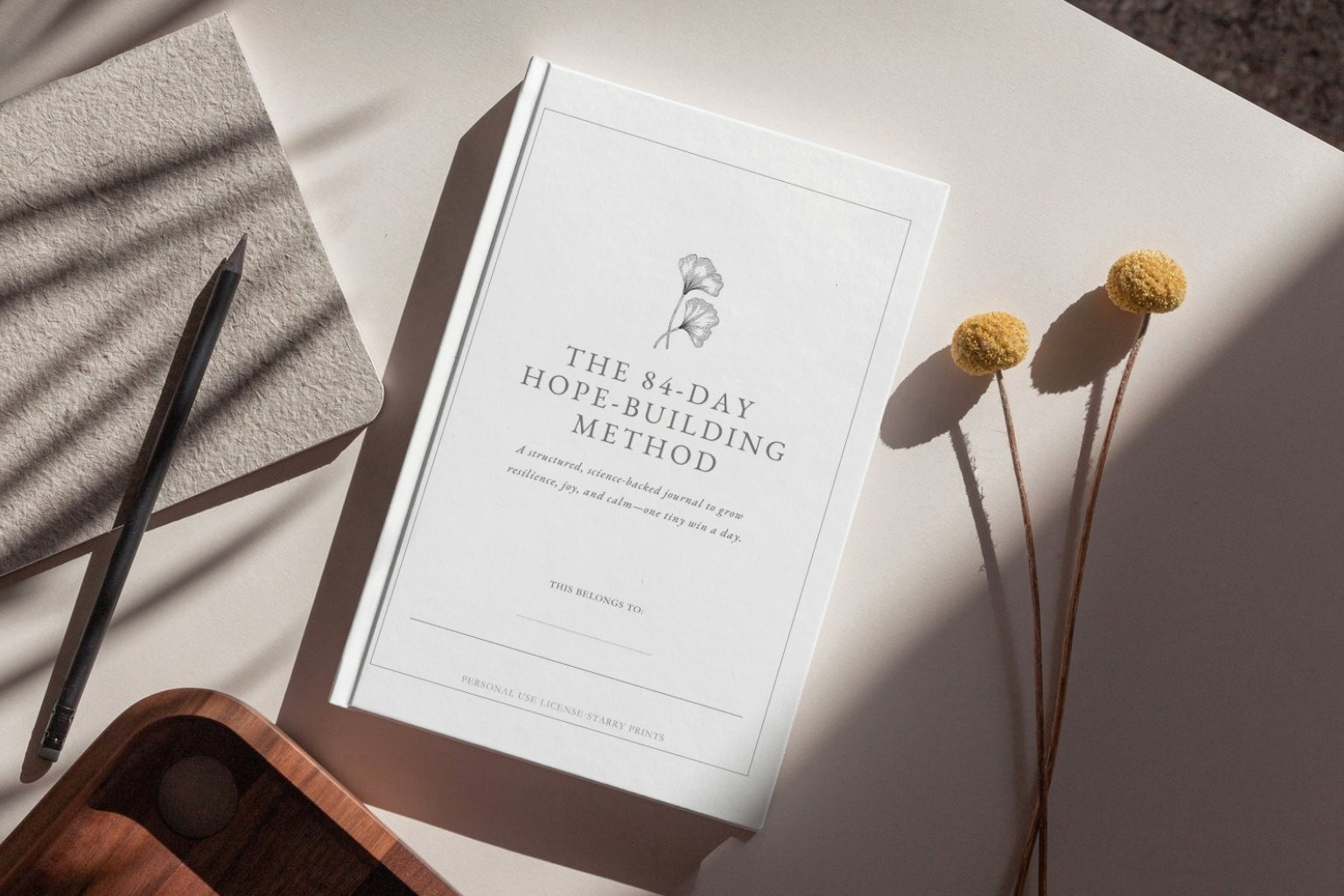
If you want something more structured than holiday prompts, meet the 84-Day Hope-Building Journal—a science-backed, printable system that turns one specific prompt a day into steady calm, resilience, and meaning.
- Guided journey: 3 stages · 12 weekly cycles.
- FFB method: Fact • Feeling • Because → real stories your brain keeps.
- Weekly reviews: notice progress without pressure.
- Printer-friendly: A4 + US Letter · instant download · personal-use license.