
How to Use Gratitude Prompts: A 3-Stage Method for a Happier Life
Learn how to use gratitude prompts the right way. This guide details a 3-stage, 84-day method with the FFB technique for building a gratitude journal practice for mindfulness and a happier life.

You've probably heard that a gratitude journal can change your life, but maybe you've tried it and felt... underwhelmed. If so, you're not alone. We believe gratitude isn't about ignoring the hard things; it's about intentionally training your attention to find the small, specific moments of goodness that carry you through. This guide will teach you a structured, science-backed method to turn a simple gratitude prompt into a transformative practice.
As a stationery lover, I was excited to start a gratitude journal. But every notebook I bought asked the same generic question. After five days, I was bored, writing the same things and feeling no real change. It wasn't guiding me to be more mindful; it was just a chore. So, I researched the cognitive science of how to rewire the brain effectively and developed the FFB method and a 3-stage journey. The difference was immediate. The structure made the practice deeper, more engaging, and—most importantly—easier to stick with.
What Is the "Right Way" to Answer a Gratitude Prompt?
Short answer: The most effective way to answer a gratitude prompt is to transform it from a simple thought into a powerful, multi-sensory memory. You can do this with the Fact-Feeling-Because (FFB) method, a technique that activates your brain's memory, emotion, and logic centers all at once.
Fact: Objectively describe what happened.
(e.g., 'Today I noticed...' / 'I heard...' / 'Someone did...')Feeling: Name the specific emotion it gave you.
(e.g., '...and I felt calm / seen / proud / cozy.')Because: Explain why it mattered to you.
(e.g., '...because it reminded me / it helped me / it meant...')

How Do You Build a Lasting Gratitude Habit? The 3-Stage Journey
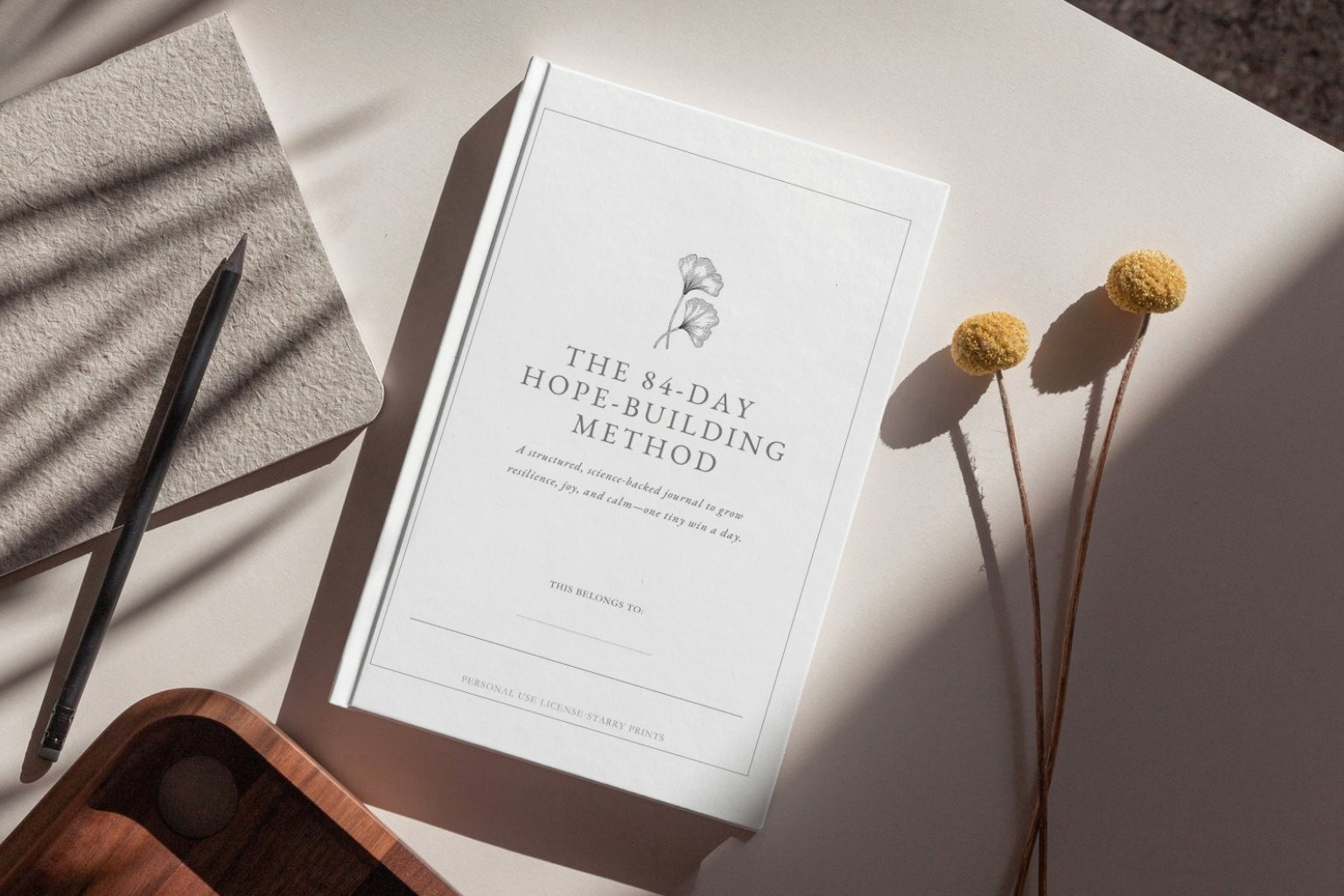
Short answer: A truly effective gratitude journal practice is a journey, not a race, unfolding over three progressive stages. This 84-day model is designed to first build a consistent habit with minimal effort, then deepen the practice to build psychological resources for a happier life.
Stage 1 (Days 1-28): Habit Formation
The only goal here is consistency. This stage uses simple, low-effort prompts focused on sensory details ("What color did you see?") to wire the new habit into your brain with a high chance of success.
Stage 2 (Days 29-56): Cognitive Deepening
With the habit in place, the prompts become more reflective. This stage guides you to use gratitude to reframe past experiences and build what's known as "Hope Theory's" two engines: Agency (your willpower) and Pathways (your ability to find new routes to your goals).
Stage 3 (Days 57-84): Character Integration
This final stage elevates the practice from a task you do into a part of who you are. The prompts focus on turning gratitude outward through rituals and social connection, making it a natural part of your identity.

Example Gratitude Prompts for Each Stage
Short answer: The prompts in a guided journal should evolve as you progress. They start with simple observations to ensure success and gradually ask for more reflection to build resilience and mindfulness.
Prompts for Stage 1 (Habit Formation)
- Day 6: "Be grateful for one simple thing your body did for you today (like breathing, walking, or seeing)."
- Day 14: "Be grateful for a quiet moment you had to yourself today."
Prompts for Stage 2 (Cognitive Deepening)
- Day 31: "List three personal qualities you are proud of. Choose one and describe a specific time it showed."
- Day 38: "Think about a mistake you once made. What valuable lesson did you learn from it?"
Prompts for Stage 3 (Character Integration)
- Day 63: "Describe a simple 'trigger' that can instantly put you in a state of gratitude (e.g., a cup of tea, a specific song)."
- Day 84: "Be grateful for a role model who showed you what gratitude looks like. How will you carry on their spirit?"

How to Start Your Practice
- Commit to the Journey, Not the Race: Accept that the goal is lasting change, not speed.
- Start with Stage 1 Prompts: Begin with simple, sensory-based prompts to build consistency with minimal effort.
- Use the FFB Method for Every Entry: For each prompt, write one line for the Fact, one for the Feeling, and one for the Because.
- Practice the "Mindset Shift": If a prompt doesn't fit, don't skip it. Use the opportunity to adapt the prompt to your reality.
- Complete Every 7-Day Cyclical Review: Block out 10 minutes at the end of each week to reflect on your entries. This is where the deepest learning happens.

The Golden Rule: No Guilt, No "Catch Up."
If you miss a day, simply resume with the current day's prompt. A short, consistent practice rewires your brain better than long, irregular bursts. Momentum is more important than perfection.
The Science Inside the Journal
- The Habit Loop (Charles Duhigg): The journal uses a `Cue` (the daily prompt) → `Routine` (your 3-minute writing) → `Reward` (the release of dopamine) to build the habit automatically.
- Episodic Memory (Endel Tulving): The FFB method forces you to recall specific scenes, which activates the hippocampus and makes the memory "stick" more effectively than a generic list.
- Broaden-and-Build Theory (Barbara Fredrickson): The positive emotions you generate literally broaden your mindset, helping you see more possibilities and build psychological resources.
- The 'Find, Remind, and Bind' Function (Sara Algoe): Gratitude helps us *find* good people, *remind* us of the goodness in our relationships, and *bind* us closer through appreciation.

Frequently Asked Questions
What is the FFB Method?
It's a science-backed gratitude prompt framework: Fact (what happened), Feeling (the emotion it caused), and Because (why it mattered). It makes any entry more impactful for your brain.
Why is a 3-stage, guided journal better than a blank one?
A guided structure removes the "what should I write?" problem and takes you on a curated journey from habit-building to deep cognitive change, which is difficult to achieve on your own.
How does this method specifically help with mindfulness?
The FFB method is a mindfulness exercise in itself. It trains your "attentional spotlight" to systematically scan for and focus on positive details in your environment and your inner world.
What if I'm short on time?
The goal in the first stage is consistency, not perfection. If you're short on time, just completing the "Fact" and "Feeling," or even writing a single word for each, is a successful practice.
A Tool, Not a Test
The goal is to train your ability to find the good; it is not about being perfect. Every time you successfully "shift your mindset" for a prompt, your psychological resilience is growing. This journal is a well-being tool, not a substitute for professional care. If you are struggling with persistent mental health challenges, please seek support from a qualified therapist or counselor.